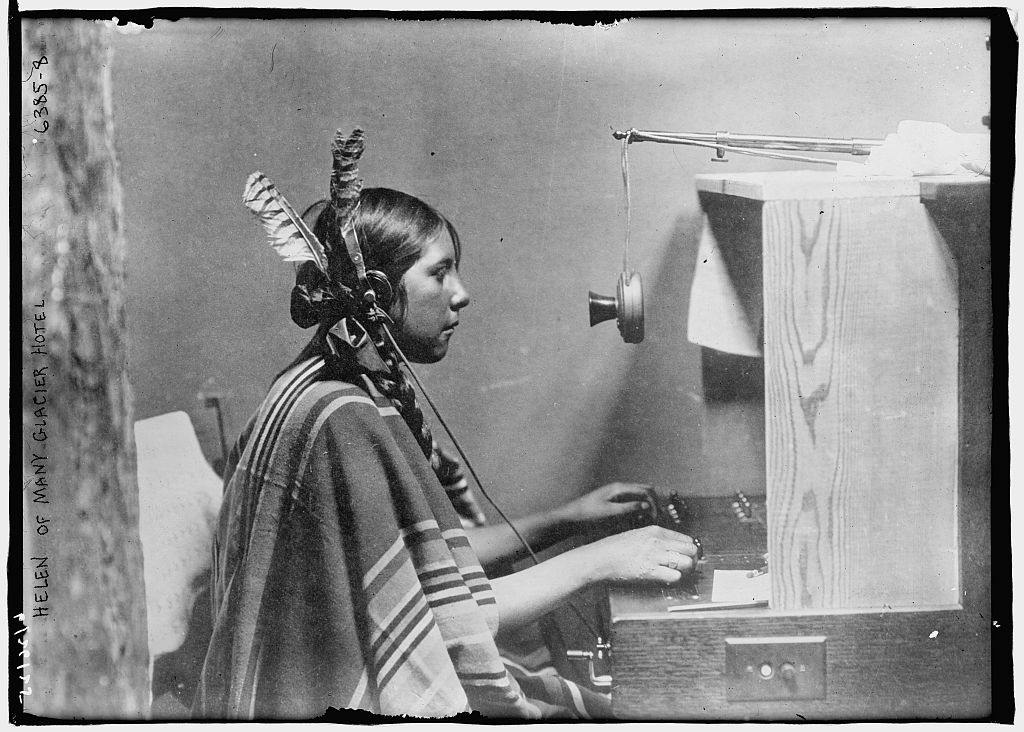
When someone called a large hotel, a room number was only useful if the call could get to the right telephone. On a manual switchboard, that connection was a physical task. An operator noticed a light, plugged into the incoming line, heard the request, and connected the call to another line. The caller heard a voice and, eventually, a ring. At the other end of the process was a person reading a panel and deciding what to do next.
That sequence helps explain why an old hotel switchboard is an interesting object for game designers. It brought signals, conversation, and decisions into a single workspace. Every part of the board had a job, and the operator had to read the parts together. A game can make the same kind of work playable by giving the player a small set of tools and a reason to pay attention to the order in which things happen.
The room behind the hotel telephone
An archival photograph shows Genevieve Brophy and Anna Fuchs beside the switchboard at Tacoma’s Hotel Winthrop. The catalog identifies them as employees of the local telephone company’s main central office. It locates the switchboard in a private room on the hotel’s roof garden floor. The picture documents a piece of infrastructure that was physically part of the hotel but outside the public view. A guest could use the service from a room without ever seeing the desk that made the connection possible. Tacoma Public Library’s Hotel Winthrop photograph
The photograph raises a practical question. How could someone keep track of many conversations on a board made of lights, jacks, and cords? Lois Lopatin’s account for the Rhode Island Computer Museum gives one answer from her own work on comparable equipment. She recalls answering when a light flashed, using one end of a cord pair to speak to the caller, and plugging the other end into the requested line. She had trained in Boston in 1957 before taking temporary assignments. Her account explains the sequence of actions behind the photograph without assuming the Tacoma operators used an identical model. Rhode Island Computer Museum’s switchboard and operator recollection
Each step changes the information available to the operator. A light reveals that a line needs attention. The conversation supplies the request. The board provides a way to act on it. The first and third steps are visible. The middle one depends on a person listening carefully. This distinction is useful when thinking about historical interfaces. Some information belongs on the panel. Some can only come from the person at the other end of the line.
What the operator needs to know
Picture a caller asking for a room, then changing the request before the operator completes the connection. The operator has to keep track of which cord carries the conversation while finding the new destination. In a game, that moment could be represented with two very simple signals. A steady light could mark an occupied line, and a second indicator could show where it is about to go. The drama would come from deciding what to do with a changing request. The signals would keep the basic operation clear.
There is a difference between memorizing a panel and understanding the job it supports. An experienced operator could recognize a common request quickly because it fit a routine. An unfamiliar request might take longer even on the same board. A game can teach the routine with an ordinary call, then ask the player to apply it when the caller hesitates or a second light flashes. The rules remain recognizable as the situation grows more complicated.
This is where interface design in narrative games connects directly with the history of the switchboard. A light can tell the player that someone is waiting, a voice can provide a fragment of the story, and the act of routing the call can determine what happens next. The interface gives the player a way to act while the conversation supplies a reason to care about the decision.
From cords to an on-screen catalog
Night Signal Entertainment’s Home Safety Hotline offers a fictional example of work built around incoming calls. Its player answers questions about household hazards, searches a catalog presented through a 1990s computer interface, and tries to match callers’ descriptions with the right information. The game also lets the player put callers on hold. That familiar action creates time to think while keeping the unfinished conversation in mind. The developer’s description of Home Safety Hotline
The two jobs involve different choices. A hotel operator connects a caller to a person or extension. The fictional hotline operator interprets a description and chooses advice from a catalog. In both cases, the first signal tells the operator very little about what the caller actually needs. The content arrives through listening. The equipment or software then makes certain responses possible. The shared pattern is what makes the comparison useful. One example shows the physical work of making a connection. The other shows how a game can turn the same division between listening and acting into a recurring decision.
The use of an on-screen catalog also highlights what changes when a job moves onto a computer. On the old panel, a connection leaves a visible cord between two points. On a screen, an interface has to choose how it will represent that state. A persistent label beside a call could show that someone is still on hold while the player looks elsewhere. A sound or a change in color could draw attention back to it. Those are design choices about memory as much as appearance. They determine which details the player can consult and which ones the player has to carry from one task to another.
Designing a hotel scene around a single call
Imagine a playable scene built around a guest trying to reach someone elsewhere in a hotel. Give the player a few room extensions, a front desk line, and a line for staff. Let the first caller give a clear destination so the player can learn what a completed connection looks and sounds like. Later, introduce a caller who asks for a person by name and has the wrong room number. Now a small directory and a short conversation can matter as much as the controls. The same board supports a different kind of decision.
A scene like that can draw on a photograph for the scale and arrangement of the equipment, and on an operator’s recollection for the sequence of work. The fictional conversation can do something those records cannot. It can put the player in a situation where they must decide what to do with incomplete information. Keep the distinction clear when presenting the finished scene. The historical sources explain what the tools did. The invented call explores what using those tools might feel like from one moment to the next.
The hotel switchboard is revealing because its machinery and its social purpose fit together so closely. A cord records a connection. A voice explains why the connection matters. A game based on that simple arrangement can make an otherwise invisible part of hotel work understandable by asking the player to do it, one call at a time.