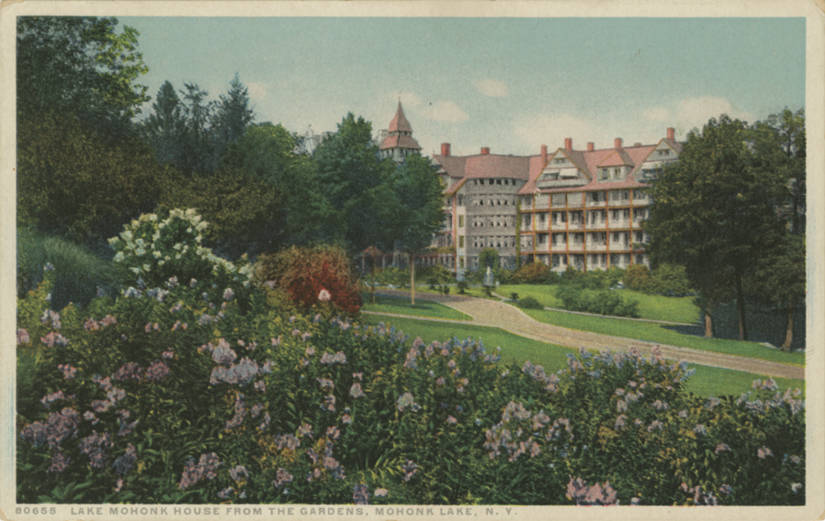
Spread out the Mohonk Mountain House floor plan and you’ll find the game room on the first floor, tucked near the parlor. Billiards gets its own spot one level down, on the ground floor. It’s an easy detail to skim past. Look again, though, and it says something about how this old Hudson Valley resort thinks about play. One space sits among the cluster of rooms around a parlor, where people drift in and out. The other gives a single game a home of its own. Both are simply part of the building a guest wanders through on an ordinary afternoon.
Game rooms tend to tell you things the postcard view of a grand facade never will. Somebody had to decide how much floor to hand over to an activity, where the clatter of it would carry, and how easily a stranger could join in or just stand and watch. You can see those decisions playing out in quite different ways at three old resorts: Mohonk in New York, Bedford Springs in Pennsylvania, and The Broadmoor in Colorado Springs. Between them, their records show play taking all sorts of shapes, from a room set aside for billiards to a bowling venue and a hunt for stories hidden in a hotel’s own paintings.
A billiard room in an 1809 travel account
Start in Pennsylvania, because Bedford Springs left behind a lot of paper. The story goes back to a country doctor named John Anderson, who began turning the land around the mineral springs into a resort in 1806, according to the hotel’s National Historic Landmark nomination. Tucked among that document’s sources is a travel account from 1809, written by someone who clearly enjoyed listing things. Springs, lodgings, baths, and then, almost in passing, a billiard room.
That last item is easy to read past, which is exactly why it’s interesting. The billiard room turns up in the same breath as the lodging and the water cure, simply another thing a visitor could expect to find. Even in its first few years, indoor recreation sat right alongside the springs that were supposed to be the whole point of the trip. You can read the full Bedford Springs Hotel Historic District nomination through the National Park Service.
Bedford Springs went on to collect far grander visitors. James Buchanan liked it so much he kept coming back as president, which is how the place got nicknamed his summer White House. In August 1858 he was staying there when Queen Victoria’s congratulations came clattering in over the brand-new transatlantic telegraph. The billiard room was there long before any of that.
What a billiard table asks of a building
Billiard tables are bossy. You can’t shove one into a corner, because the player needs room to draw the cue back on every side, and the people waiting their turn want somewhere to lean, ideally a bench along the wall with a view of the table. That’s a lot more planning than putting a box of dominoes on a shelf.
Our 1809 traveler, sadly, wasn’t interested in any of that. We know the room existed. How many tables, where they stood, whether the doctor’s guests played after supper or all afternoon, nobody wrote down. A floor plan or a sketch might turn up one day. Until then, it’s a room with the lights off.
Two centuries later, a game you can borrow
Bedford Springs is now run by Omni, and the resort’s current page on Omni Bedford Springs indoor activities describes something rather different. Guests can ask for board games, or sign them out from Tally Ho Outfitters. The hotel supplies the box and a place to borrow it. Take it to the porch, take it to your room, the hotel doesn’t mind.
So in one hotel, two centuries apart, you’ve got both of the big ideas. In 1809 the game stayed put and guests went to it. Now the game goes wherever the guests happen to be sitting.
Mohonk, where the plan puts play in plain sight
Back in 1869 a Quaker schoolteacher called Albert Smiley bought a modest ten-room inn perched over Lake Mohonk. The family never really stopped adding to it after that. The present floor plan shows a sprawling building full of parlors, lounges and dining rooms, with rooms set aside for recreation among them. Mohonk’s account of the inn and its expansion fills in the timeline of how a small lakeside inn turned into a full-scale resort.
The two sources work nicely together, as long as you keep in mind that the floor plan shows the building as it is today. It doesn’t tell you when any particular room was added or what it was used for in 1890.
How little you need to know
What’s striking is how little a guest needs to know to use that map. The label next to the parlor tells you where to look for the game room. A separate label sends you straight to the billiards. The named rooms also give a group an easy way to split up and meet again later. Grandparents can settle in the parlor with a book while the teenagers head off to play, and nobody has to text anybody to find out where they’ve gone.
Put a game room next to the parlor and people wander into it by accident, on their way to tea. Stick it at the far end of a basement corridor and only the determined ever find it.
A map as a quiet invitation
Every guest map is a little editorial decision, too. Somebody chose which rooms to label, and those are the rooms the hotel wants you to find without bothering the front desk.
Historians treat those labels as clues and go hunting through old photographs and guests’ letters to see what actually happened in each room. A family up for the weekend doesn’t care about any of that. They just want to know the billiards is downstairs.
A bowling lane changes the scale
Out in Colorado, Spencer Penrose had made a fortune in gold and copper, and in 1918 he spent a good chunk of it on The Broadmoor, a pink-stucco resort at the foot of Cheyenne Mountain. Today its West Building houses a venue called PLAY that combines bowling with dining. Read the small print in The Broadmoor’s guest information and you’ll find you book the lane and the table separately, though nobody minds if you eat your burger between frames.
It sounds like a minor booking quirk. It’s actually a clue to how much a bowling lane bends a whole evening around itself. Once you’ve got it, it’s yours for the hour. The restaurant runs on its own schedule. Anyone planning an evening has to work out how the two fit together. The hotel’s page on PLAY at The Broadmoor shows how the two are pitched as one night out.
Lanes versus boxes
Set a bowling lane next to a borrowed board game and the contrast is almost comic. The lane, the pins and the walk to get there never move. Friends gather around the players, and whoever’s waiting for a turn gets to heckle. A board game, meanwhile, takes over a small table for an hour and then vanishes back into its box.
Both give people a reason to spend time together at a hotel. They just ask for very different things in return. Floor space is one, and so is furniture. Staff time comes into it, and so does how easily guests can come and go.
When the whole hotel becomes the board
Mohonk’s Hidden Histories project pushes that question about space a good deal further. In the resort’s 2019 write-up of its augmented reality app, guests were invited to track down twelve pieces of artwork scattered around the property. Find a painting, point the app at it, and a short video would unlock with a story about the Smiley family, the staff or past guests. Mohonk’s account of the Hidden Histories project describes how it worked.
The artwork gave each stop a real, physical place in the building. The video added the story. Together they gave guests a reason to walk corridors they’d normally hurry through, and to look properly at pictures that had been hanging there for decades.
Same principle, new equipment
Strip away the phone, though, and it’s the same trick the billiard room pulled in 1809. Show people where to start. Make the next move obvious.
Walk into a billiard room and the green cloth and the rack of cues more or less explain themselves. Mohonk’s app did it with a little gallery of pictures. Spot the real painting on the wall and you knew you’d got it. Because all the equipment fits in a guest’s pocket, the game can happen in a hallway, on a staircase or beside any wall display in the building.
Play nobody else can see
That changes what everyone else notices, too. Anyone walking past a bowling lane can tell straight away that a game is going on. Someone following an art trail, on the other hand, just looks like another guest pausing in front of a picture.
To the person holding the phone, though, that pause has a purpose. The corridor keeps doing its everyday job as a way from the dining room to the stairs, while quietly offering a second way to experience the building.
At Mohonk, finding a painting unlocks a story on a guest’s phone. A similar kind of interaction shows up in browser-based games, where what a player does shapes what they see next.
Start with the game room
All of which makes a hotel’s game room a surprisingly good place to begin looking at the whole property. Find it on the plan and ask how the activity fits around everything else a guest might be doing that day. Then go looking for the kinds of play that don’t need a room at all.
Across these three resorts, the answer turns out to be wonderfully varied. A billiard table did the job in 1809. Today it might be a bowling lane, or an ordinary stretch of wall with a painting on it. Each one is a place where people decide to linger a little longer, and to do it together.