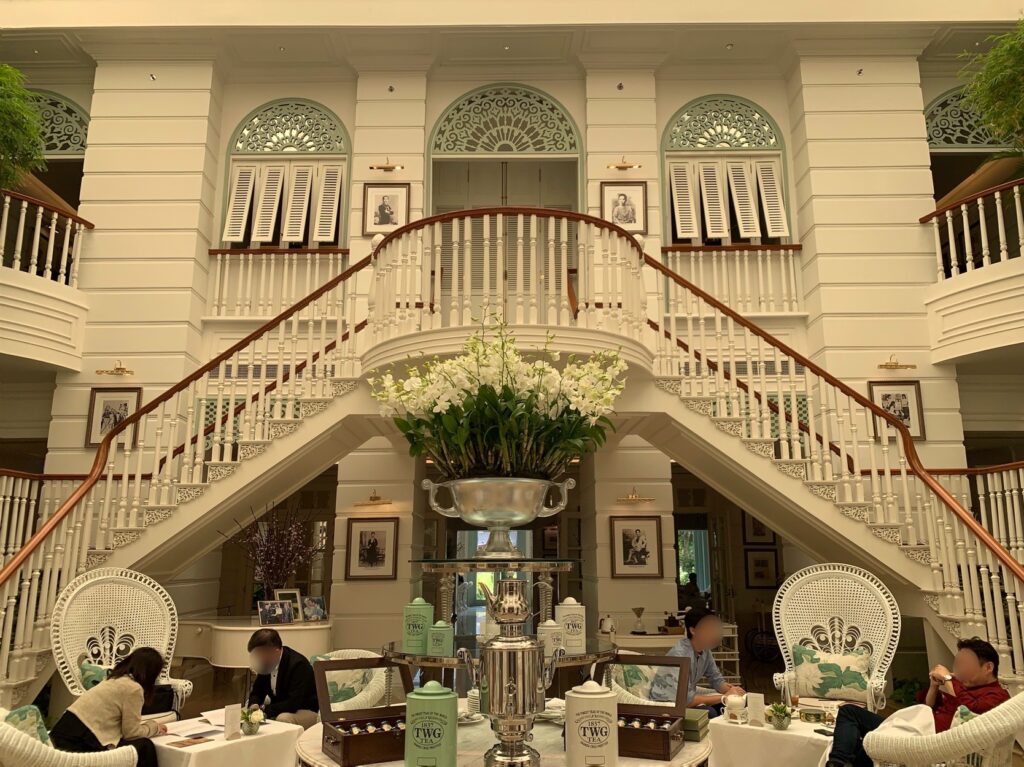
Featured photo · Original image · CC BY-SA 4.0

The framed writers in the Authors’ Lounge of Mandarin Oriental, Bangkok, belong to a room that still has a daily life. The hotel describes the lounge as a ground-floor space in the original Oriental Hotel where afternoon tea is served. Photographs share the room with furniture and fabrics chosen to evoke an earlier period. Someone can sit down for tea and encounter a small exhibition without crossing a museum entrance or following a prescribed route.
That arrangement changes how the photographs are read. In a dedicated gallery, a wall label might direct the visitor from a portrait to a date and then to a section about an author’s work. In a lounge, a photograph might first be noticed across a table or while someone is looking for a seat. The Path of History exhibition gives those brief encounters a subject. It brings together people connected to the hotel through writing and travel, and it asks what can be learned from the places where writers spent time away from home.
Two ways to encounter the hotel’s past
Path of History’s Bangkok archive describes The Oriental Journey as an exhibition built around the history of the hotel. It draws on a book about the property and treats the hotel itself as the main subject. The Authors’ Lounge exhibition record narrows the view to writers whose visits became part of the hotel’s memory. The difference is visible in what each display asks a reader to follow. One starts with a place and looks outward across its history. The other starts with a person and follows a relationship back to the place.
The two approaches can complement each other. A property history offers chronology and gives context to changes in how the building was used. A group of portraits gives that chronology points of contact with individual lives. It also invites questions that a hotel timeline alone cannot answer. A writer might be remembered for a visit, for a book associated with that visit, or because the hotel later named a space after them. Those connections are related, and each calls for different evidence.
The historical exhibition record credits Andreas and Carola Augustin as curators of the Authors’ Lounge display. It also identifies hotel general manager Amanda Hyndman as a supporter of the project. Those credits help readers see the display as an act of selection. The portraits form a collection because people researched, chose and placed them in a particular room. Reading the credits alongside the images gives that modern exhibition work a place in the story.
When a name becomes a room
The hotel’s description of the Authors’ Lounge notes four adjoining rooms and describes photographs of writers who stayed at the hotel. Its account of the Authors’ Wing names Joseph Conrad and W. Somerset Maugham among the writers remembered in its suites. The use of these names makes the literary connection visible in everyday directions. A name on a plan or a door can send a visitor back to a photograph or toward a book they have never read.
A named room is a form of commemoration. It does not, by itself, establish which room someone occupied or what they did there. The name of a contemporary salon, a dated photograph and a published account of a stay are three different objects. The salon shows how the hotel remembers the writer. The photograph records a specific moment when its date and location can be established. The published account can provide a writer’s own view, while still reflecting the choices that writer made when telling the story. The value of seeing them together is that they give the reader several ways to ask what the connection meant.
That distinction also gives the display some staying power. A visitor who recognizes only one name can follow a smaller question, such as why that name appears on this wall and what evidence connects it to the hotel. Someone familiar with several writers can look at how differently they are represented. A portrait, a short description and a room name may seem modest, yet together they show how literary memory is made in a public place.
How to read a wall of photographs
Start with the caption. The useful details are often simple. Who is pictured? Does the caption say where the photograph was taken? Is there a date, a credited photographer or a reference to a source? A portrait made elsewhere can still be relevant to an exhibition about a hotel guest. Its relevance comes from the person it identifies, rather than from what it can show about the hotel itself.
Then look at the order of the photographs. A wall arranged around people offers a different reading experience from a timeline. It makes it easy to compare faces and names, but it can bring people from separate periods close together. Two neighboring portraits do not imply that the writers met or visited in the same year. The arrangement instead makes a broader argument about the range of people a single place can remember.
Finally, look at the room surrounding the photographs. The hotel describes the furnishings as evocative of the early twentieth century. That description speaks to how the room is presented to visitors. It is a different claim from saying that a particular chair or fabric dates to a writer’s visit. When an object’s age or provenance is known, a caption can make the distinction. When the design is interpretive, the room still tells a story about the atmosphere the hotel chose to preserve or evoke.
Reading the gallery away from the hotel
The exhibition record gives readers a way to revisit the portraits from outside Bangkok. On a screen, the photographs become easier to look at one by one. The screen also removes some of the information that the room supplies. It may be hard to tell which pictures are seen together, how high they hang, or what a visitor notices first. The hotel’s description locates the display within a functioning lounge and helps restore that context to the gallery.
This is one reason to use both records. A photograph of the exhibition can show how the portraits relate to the room, while an individual image may make a name or detail easier to read. It is worth distinguishing what belongs to the picture from what belongs to its presentation. The online gallery, like the lounge itself, is a way of arranging material for an audience. Its value lies in what it lets readers inspect and compare, including details that a glance across a crowded room might miss.
A literary exhibition in a room people still use
There is a practical reason the Authors’ Lounge matters to hotel history. A person can engage with it at different speeds. The first encounter may last as long as a glance. A return visit or a closer look at the exhibition record can turn that encounter into a question about a writer, a book or a building. The same display accommodates people who came for the room and people who came for its history.
The wider Oriental Journey provides the setting for those individual encounters. The Authors’ Lounge supplies names and faces. Reading the two exhibitions together gives the old hotel both a chronology and a set of human connections. It also shows how an institution can keep literary history in view while the room continues to do the work for which people visit it today.